
Lattice QCD at Scale
Algorithms, software, and physics results built for the next generation of supercomputers.
The ASCR/NP LQCD SciDAC Project develops the theoretical methods, software infrastructure, and production workflows needed to extract new physics from lattice quantum chromodynamics on leadership-class computing platforms.
Mission
Connecting computation to nuclear physics discovery
This project focuses on ambitious theoretical, algorithmic, and software development that enables lattice QCD calculations to exploit leadership-class resources and dedicated hardware. The work advances fundamental studies of hadrons, nuclei, and strongly interacting matter while delivering the computational methods needed for modern large-scale simulations.
The resulting calculations inform heavy-ion experiments at RHIC, spectroscopy programs at CLAS12 and GlueX, hadron and nuclear structure studies at Jefferson Lab and RHIC-spin, and future measurements at the Electron-Ion Collider.
Research pillars
Where the collaboration is investing effort
Hadron spectroscopy
Resolving excited and exotic states with controlled lattice calculations tied to experimental programs.
Structure of hadrons and nuclei
Mapping the internal dynamics of quarks and gluons in protons, mesons, and light nuclei.
Hot and dense QCD matter
Studying thermodynamics and transport relevant to heavy-ion collisions and neutron-star phenomenology.
Performance-critical software
Developing multigrid solvers, gauge generation methods, and accelerator-ready implementations.
Featured work
Recent highlights from the project
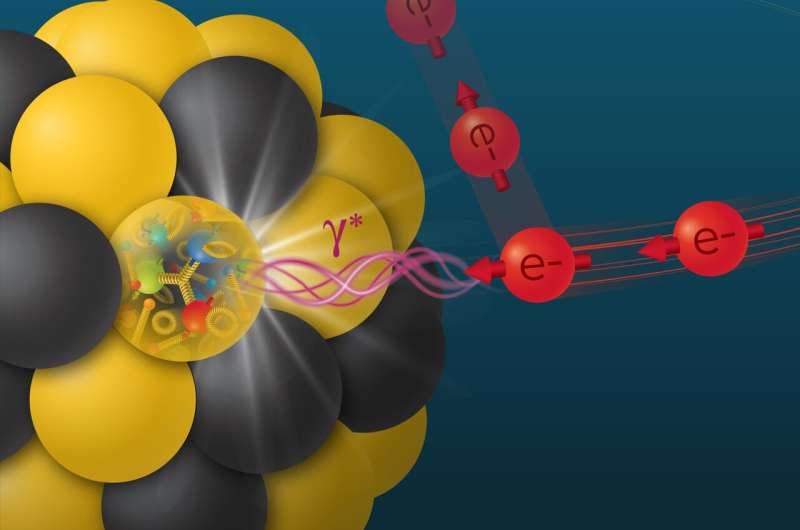
Predictions for Electron-Ion Collider measurements
Meson charge-distribution calculations benchmark future measurements and test widely used factorization methods.

Drilling into neutron stars with computers
Simulations of neutron stars constrain internal pressure and maximum mass through large-scale numerical studies.

Excited hadrons and the X(3872) puzzle
Lattice QCD calculations sharpen the interpretation of charmonium-like and exotic XYZ states.
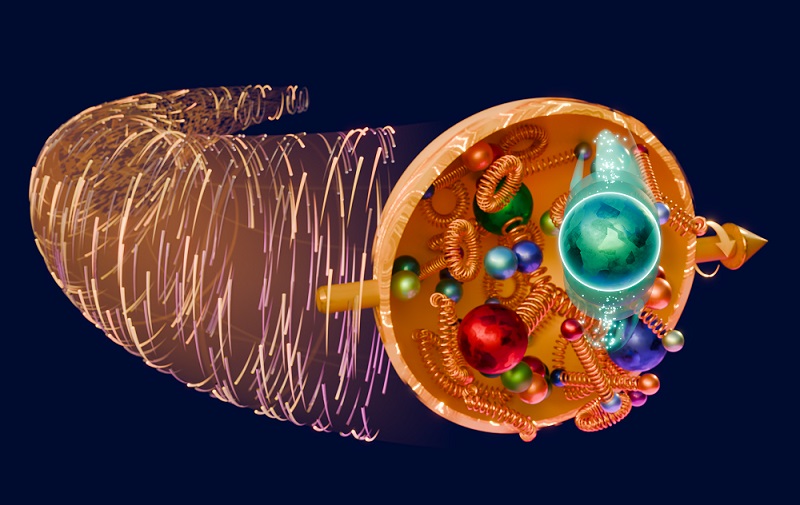
Sharper imaging of proton structure
A new theoretical approach improves calculations of the three-dimensional motion of quarks inside the proton.
Explore
Quick access to the rest of the site
About the project
Background, scientific motivation, and collaboration goals.
SciDAC program context
How this effort fits into the broader DOE computational science portfolio.
People
Participating investigators, institutions, and collaborators.
Publications
Peer-reviewed outputs and project-related references.